




A cricket player auction can shape an entire tournament before the first ball is bowled.
Every squad, every rivalry, and every underdog story on the field can trace back to a room — physical or digital — where team owners raised paddles and numbers climbed. But behind that energy sits a system that has to work: a system built on verified player data, clear auction rules, disciplined budgets, and transparent records.
This guide walks through exactly how tournament organizers, club administrators, and league operators can run a cricket auction that teams actually trust — from the first player registration to the final signed contract.
What Is a Cricket Player Auction?
A structured process where team owners or managers bid competitively to acquire players for their squad, within a fixed budget known as a purse.
Unlike a simple draft, an auction lets market dynamics decide value — popular all-rounders and proven finishers often draw competitive bidding, while role-specific players may go for their base price. This is what makes auctions exciting for fans, but it also means the process needs strict rules to stay fair.
Eight Steps to a Trusted Auction
Tap or hover any card to see the key takeaway for that step.
- Step 01 Build a Reliable Player Pool Every trustworthy auction starts long before bidding — with a clean, verified list of players.
- Step 02 Establish Clear Auction Rules Rules aren't a formality — they're what teams point to when a bid is disputed.
- Step 03 Create a Bidding Strategy Organizers who share planning tools in advance see far fewer overspends on auction day.
- Step 04 Choose Auction Technology In-room, hybrid, or fully remote — the format changes what technology you need to keep things fair.
- Step 05 Run a Full Rehearsal A mock run with dummy players exposes exactly where the process will slow down.
- Step 06 Conduct the Live Auction On the day, structure and pace matter as much as the rules themselves.
- Step 07 Manage Unsold Players An unsold player isn't a rejected player — the process needs to reflect that.
- Step 08 Complete Contracts & Records A winning bid only becomes real once it's documented and signed.
Build a Reliable Player Pool
Every trustworthy auction starts long before bidding — with a clean, verified list of players.
Organizers should collect standardized information for every registering player: full name, age category, primary role (batter, bowler, all-rounder, wicketkeeper), batting and bowling style, playing history, and current availability for the tournament window.
What "verified" actually means
- Identity and age proof checked against tournament eligibility rules
- Role and skill details confirmed, not self-reported only
- Prior team or contract conflicts flagged before the auction, not during it
- A consistent base price category assigned to each player
A messy player pool is the single biggest cause of disputes mid-auction — teams arguing over eligibility while the clock is running is exactly what a good process avoids.
Establish Clear Auction Rules
Rules aren't a formality — they're what teams point to when a bid is disputed.
Beyond these, document your dispute rules — who has final say if two owners claim the same bid, and how that decision gets recorded.
Help Teams Create a Bidding Strategy
Organizers who share planning tools in advance see far fewer overspends on auction day.
Encourage each team to rank players by role priority before the auction, set a maximum bid ceiling per player, and reserve a portion of their purse for mid- and late-auction opportunities. Teams that spend 70% of their budget on the first few marquee names often struggle to fill out a balanced squad later.
A simple planning sheet — role needed, target players, maximum bid, backup options — turns a chaotic bidding war into a disciplined process.
Choose the Right Auction Format and Technology
In-room, hybrid, or fully remote — the format changes what technology you need to keep things fair.
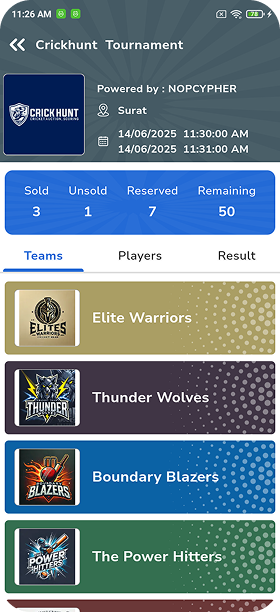
Smaller local tournaments often run in-person auctions with a whiteboard and a spreadsheet — and that can work fine for a handful of teams. Larger or multi-city tournaments increasingly rely on digital bidding software so remote owners can participate live, budgets update automatically, and every bid is timestamped.
Illustrative Auction DashboardConduct a Full Auction Rehearsal
A mock run with dummy players exposes exactly where the process will slow down.
Test every team's login and bidding access, walk through a full player card end-to-end, confirm budgets deduct correctly, and check that unsold logic behaves as expected. If you're using a digital platform, this is also the moment to confirm your audit log is actually capturing every action.
Run the Live Cricket Auction
On the day, structure and pace matter as much as the rules themselves.
Appoint a clear auction commissioner to run the floor, present players in a predictable order (often marquee names first, grouped by role), and call each sale clearly before moving on. Keep a visible running total of each team's remaining purse so bidding stays grounded in reality rather than momentum alone.
Manage Unsold Players
An unsold player isn't a rejected player — the process needs to reflect that.
Most professional auctions move unsold players to a second round rather than removing them outright. As teams' priorities shift and budgets free up later in the day, players who went unsold in round one are frequently picked up in round two. Communicate this process to players in advance so an unsold result on the first pass doesn't feel final.
Complete Contracts and Auction Records
A winning bid only becomes real once it's documented and signed.
Within days of the auction, issue each sold player a written contract stating the agreed price, role, and tournament obligations. Keep a master record — a full audit trail of every bid, sale, and unsold decision — that any team can refer back to if a question comes up weeks later.
Who Benefits From a Professional Cricket Auction?
A disciplined process pays off for everyone in the room — not just the winning bidder.
Tournament Organizers
Fewer disputes, a cleaner schedule, and a process they can reuse season after season.
Team Owners
Confidence that every bid, budget, and squad decision is tracked and defensible.
Coaches & Analysts
Verified player data they can actually plan a season around.
Players
A transparent, fair shot at being seen and valued for their role.
Corporate Leagues
A repeatable format that scales cleanly across departments or branches.
College Tournaments
A structure that runs smoothly even with limited organizing staff.
How Digital Auction Technology Can Simplify the Process
Every step above can be run on paper — but digital tools remove a lot of the room for error.
 Example Platform
A digital cricket auction platform typically handles the operational load that's easy to get wrong manually: live bidding across devices, real-time team budgets, current player status, a searchable bid history, and remote participation for owners who can't be in the room. Sold and unsold tracking updates instantly, and auction reporting is generated automatically instead of being reconstructed from notes afterward.
- Live bidding synced across every connected device
- Automatic budget deduction as each player is sold
- Real-time player status: available, sold, unsold, reserved
- A full bid history for post-auction reference
- Remote participation for owners in different cities
- Auction reports generated automatically, not manually
CrickHunt is one example of a platform built around these needs — cricket auction and scoring tools designed for organizers running tournaments of any size. Whichever platform a tournament chooses, the goal is the same: keep the process fast, visible, and trustworthy to every team at the table.
Key Benefits of Using CrickHunt
Where CrickHunt specifically fits into the process described above.
Live, Synced Bidding
Every team sees the same bid, budget, and player status in real time.
Automatic Records
A built-in audit trail means no reconstructing decisions from memory.
Remote-Friendly
Owners can bid from anywhere without losing visibility into the room.
Cricket Auction Checklist
Work through this before auction day. Your progress is saved automatically on this device.
Frequently Asked Questions
How do you conduct a cricket player auction?
Build a verified player pool, publish clear auction rules covering purses, bid increments and squad limits, help teams plan their bidding, choose a format and technology, rehearse the process, then run the live auction, settle unsold players, and complete contracts and records.
What information should be collected for a cricket auction?
Full name, age category, primary role (batter, bowler, all-rounder, wicketkeeper), batting and bowling style, playing history, and current availability for the tournament window.
How can teams avoid overspending?
Rank players by role priority before the auction, set a maximum bid ceiling per player, and reserve a portion of the purse for mid- and late-auction opportunities.
What happens when a player receives no bid?
Most professional auctions move unsold players to a second round rather than removing them outright, and players who went unsold in round one are frequently picked up in round two.
Can cricket auctions be conducted remotely?
Yes. Digital bidding software lets remote owners participate live, updates budgets automatically, and timestamps every bid.
Is a digital platform necessary for a small tournament?
Not always. Smaller local tournaments can run in-person auctions with a whiteboard and a spreadsheet, which works fine for a handful of teams. Larger or multi-city tournaments benefit far more from digital bidding.