




A player is called. The bidding numbers start climbing. In a traditional cricket auction, everyone making that decision — the owner, the manager, the head coach — has to be sitting in the same hall. If one of them is travelling, tied up at work, or simply based in another city, they either miss the moment or lean on someone else to decide for them.
Remote bidding removes that constraint. It lets a team owner follow the live auction and place bids from wherever they happen to be, using the same sequence of players and the same real-time information that owners inside the venue are working with. This article walks through what that looks like in practice, why it matters, and how a platform like CrickHunt fits into the picture.
What is remote bidding in a cricket auction?
Remote bidding is simply the ability to take part in a live player auction without being physically present at the venue. Instead of raising a paddle in the room, a team owner watches the same live auction and places bids as each player comes up — from a laptop, tablet or phone, wherever they are.
The key idea is that nothing about the auction slows down or changes for a remote owner. Players are still called in order, bidding still happens in real time, and the winning bid is still recorded as part of the same live process. The only difference is where the owner is sitting when they make the call.
Consider a simple example: a team owner is travelling on the day of the auction and can't reach the venue. With remote access, they can still watch each player be introduced, see the current bid as it rises, and respond immediately — instead of asking a colleague to bid on their behalf and hoping the instructions were followed exactly as intended.
Why team owners may need remote auction access
There are several everyday reasons a team owner might not be able to attend an auction venue in person.
The owner is in another city
Tournaments and auctions don't always take place close to where every owner is based, especially for teams built from players and management spread across regions.
Travel takes time
Even when travel is possible, it takes planning and time that isn't always available on short notice before an auction date.
Work or personal commitments
Owners often manage a team alongside a job or business, and commitments can clash directly with an auction's schedule.
More than one decision-maker
Team decisions often involve an owner, a manager and a coach — and coordinating everyone in one venue isn't always realistic.
Auctions happen live
Unlike decisions that can wait, an auction moves player by player in real time, so being unavailable at the wrong moment has an immediate cost.
The auction doesn't pause for anyone — so the question isn't whether an owner can catch up later, it's whether they can be part of the moment as it happens.
How does a remote cricket auction work?
At a high level, a remote cricket auction follows the same sequence as an in-person one. The only change is where the team owners are sitting when they join it.
- Step 1
Tournament and auction setup
Players and teams are prepared ahead of the auction date, so the player pool and squads are ready before bidding opens.
- Step 2
The player auction begins
The organizer starts the auction and players are introduced for bidding, one at a time, in a set order.
- Step 3
Owners join remotely
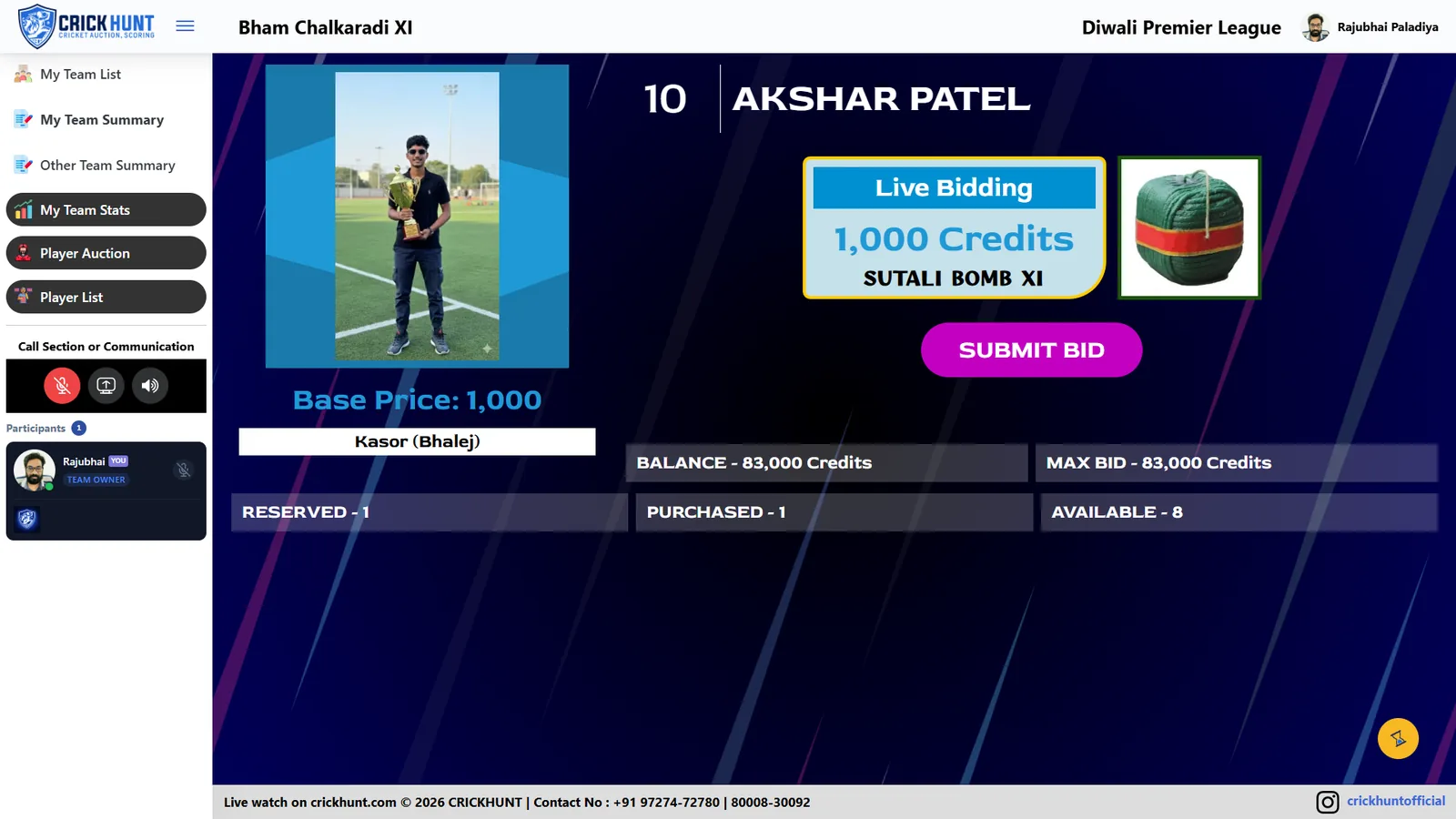
Owners who aren't at the venue open the auction on their own device and see the same live player, bid and budget information as the room.
- Step 4
Live bidding takes place
Teams place their bids while the player is active. Remote owners bid in the same window as everyone else, with no separate round.
- Step 5
The winning bid is recorded
The player goes to the highest bidder and the result is logged, with that team's budget updated straight away.
- Step 6
Squads keep building
The next player is called and owners carry on, tracking their remaining budget and priorities for the players still to come.
What remote bidding changes about the auction
Physical-only participation
- Travel is required to reach the venue
- Everyone needs to be present in one location
- Difficult for owners who can't attend on the day
With remote participation
- Owners can take part from their own location
- Greater flexibility around schedules and location
- Easier participation for teams spread across cities
What to prepare before a remote cricket auction
Joining an auction remotely still requires the same preparation as attending in person — arguably more, since there's no one beside you to double-check a decision in the moment.
Review the player pool
Know which players are available before the auction begins.
Set your priorities
Separate must-have players from your alternatives in advance.
Decide spending limits
Set a strategy before the pace of live bidding takes over.
Understand your budget
Keep track of what's left as the auction moves along.
Coordinate with your team
Make sure everyone agrees on who's being targeted and why.
Check your connection
Remote participation depends on a stable internet connection.
Benefits of remote bidding for team owners
Take part from anywhere
Owners can join without needing to be physically present at the venue.
Less travel dependency
Remote participation can reduce the need to travel specifically for the auction.
Stay connected to live bidding
Owners remain part of the decision-making as it happens, not after the fact.
Decide faster
Having auction information available digitally supports quicker, clearer decisions.
More flexibility
Owners with location or scheduling constraints can still take part fully.
How CrickHunt fits into the remote auction workflow
CrickHunt is built around cricket tournament and auction management. Within the context of remote bidding, a few parts of the platform are directly relevant.
Remote auction
Owners who can't be at the venue can take part in the auction from wherever they are.
Player auction
Supports running the player auction itself, from player introduction through to the winning bid.
Team and player management
Keeps team rosters and player details organised alongside the auction.
Budget management
Helps owners see their budget standing while building a squad across the auction.
These pieces work together as part of the same workflow — the auction itself, the teams involved, and the budgets behind each decision, all in one place, whether an owner is in the room or joining remotely.
Why a structured digital auction matters
A cricket auction generates a lot of moving information fast: player details, current bids, remaining budgets and squad composition, all changing within minutes. Keeping this organised matters for every team, but it matters even more for an owner who isn't in the room and can't lean over to ask what just happened.
A structured digital auction environment centralises this information — organised player details, team records, budget visibility and a clear record of the auction as it unfolds. That structure is what makes remote participation practical in the first place, rather than something bolted on as an afterthought.
Remote bidding best practices
Decide your strategy early
Work out your approach before the auction begins, not during it.
Set spending limits
Agree on limits in advance so bidding decisions stay disciplined.
Rank your players
Know your must-haves versus your backups ahead of time.
Avoid impulsive bids
Live bidding moves fast — stick to your plan rather than reacting emotionally.
Track remaining budget
Check your available budget continuously as the auction progresses.
Keep your team aligned
Stay in touch with your decision-makers throughout the auction.
Stay focused while bidding
Minimise distractions during active bidding windows.
Review your final squad
Once the auction ends, review what your team has built overall.
Remote cricket auction checklist
A practical checklist to work through before joining a remote auction. Tap an item to tick it off — this is a personal planning guide, not a formal requirement.
Frequently asked questions
What is remote bidding for cricket auctions?
Remote bidding is a way for a team owner to take part in a live player auction without being physically present at the venue, following the same players, bids and squad updates as the auction happens.
How does a remote cricket auction work?
Players are presented one at a time during the auction. Owners who aren't at the venue follow the same live sequence remotely and place bids as it progresses, just as owners in the room do.
Can team owners bid from another city?
Yes. Where the auction offers remote access, an owner in another city can follow the live auction and bid as it happens, without travelling to the venue.
What should I prepare before a remote auction?
Review the player pool, decide your priority players and spending limits, confirm your auction access in advance, check your internet connection, and agree on strategy with your team's decision-makers.
What is cricket auction software?
Cricket auction software is a digital platform used to run a player auction — presenting players, recording bids, tracking each team's budget, and keeping the auction organised from start to finish.
How does it help tournament organizers?
It keeps player information, bidding, budgets and squad records in one organised place, which can make the auction easier to run and easier for teams to follow, including teams joining remotely.
Does CrickHunt support remote cricket auctions?
Yes — remote auction participation is part of CrickHunt's auction workflow, alongside player auction management, team and player management, and budget management.
Planning your next cricket auction?
If you're organising a tournament and want a structured way to manage players, teams, budgets and remote participation, CrickHunt covers that workflow end to end.