




How Online Cricket Player Auctions Work: A Complete Guide for Tournament Organizers
Running a cricket tournament involves much more than scheduling matches and selecting teams. One of the most important parts of a tournament is building balanced teams — and this is where a cricket player auction can make the process more competitive, transparent, and exciting.
Traditionally, player auctions for local tournaments were managed using spreadsheets, paper lists, calculators, WhatsApp groups, and manual bidding records. As the number of players and teams increases, keeping track of bids, budgets, player categories, and final team allocations quickly becomes difficult.
An online cricket player auction brings all of these activities into one digital workflow — from player registration and verification to live bidding and final team allocation. This guide explains, step by step, how an online cricket player auction actually works.
What Is an Online Cricket Player Auction?
An online cricket player auction is a digital system where registered cricket players are placed into an auction pool and participating teams compete to select them through bidding. Instead of maintaining a manual record of every bid, the auction platform manages important information such as:
- Player profiles
- Player categories
- Base prices
- Bidding increments
- Team budgets (purse)
- Squad limits
- Current bids
- Sold and unsold players
- Final team allocations
- Live auction display
Players enter the auction, teams receive a budget, players are presented one by one, teams place bids, and the highest eligible bid wins — the player is assigned to that team. The software handles the record-keeping behind the scenes so organizers can focus on running the event.
Why Are Cricket Tournaments Moving to Online Auctions?
A player auction can become complicated surprisingly quickly. Imagine a tournament with 100 players and 8 teams. If the auction is managed manually, organizers may need to track:
- Which players have already been auctioned
- Which players are still available
- How much each team has spent
- How much money is left in each purse
- Which players belong to which team
- Whether a team has reached its squad limit
- The current bid for every player
- Unsold players
- Final auction results
Doing all of this with Excel sheets and manual calculations creates opportunities for mistakes, disputes, and delays. An online auction system reduces much of this administrative work by keeping the auction data in one place, calculated automatically and visible to everyone.
How Does an Online Cricket Player Auction Work?
Although every tournament can have its own rules, a typical online cricket player auction follows this workflow:
- Player Registration
- Verification
- Auction Setup
- Team Setup
- Live Bidding
- Player Allocation
- Final Team Data
- Scoring
Let's break each stage down. The first step is creating the player pool. Players provide the information required by the tournament organizer — typically name, profile information, playing role, batting style, bowling style, player image, and cricket statistics. When tournaments require it, this creates a controlled player database: instead of forcing organizers to collect player information separately through forms, spreadsheets, and messaging apps, everything sits in one system. Why verification matters: not every registered player should automatically appear in the auction. Organizers may want to check whether the player has provided the required information, is eligible for the tournament, and fits the appropriate player category. Verification gives organizers control over who enters the final auction pool. Once the player pool is ready, organizers can group players into categories. For example, a tournament might create: The exact categories depend on the tournament. The purpose is to make the auction easier to manage and give teams a clear understanding of the players they are bidding for. Every player enters the auction with a base price — the starting value for the bidding. The auction begins at the defined base price, and teams can increase their bids according to the rules established by the organizer. A well-planned base price keeps the auction moving smoothly — it also allows organizers to differentiate between player categories and give the auction structure. The next important part is deciding how much a bid can increase each time. These increases are commonly controlled through predefined bidding increments or slabs. This matters because the auction should move quickly, every team must know the next valid bid amount, and confusion and disputes should be avoided. With predefined bidding increments, everyone understands what the next valid bid should be — conflict is reduced and the auction stays fair and consistent. Now comes one of the most important parts of the auction: the team purse. Each team receives a predefined virtual budget. For example, imagine a local tournament has eight teams and gives each team ₹50,000: This remaining amount is extremely important because teams need to plan their purchases throughout the auction. When organizers configure the purse along with squad size constraints and other franchise rules, the auction system validates every bid and prevents teams from exceeding their available budget. Now the exciting part starts. Players are introduced one at a time: If no team makes another valid bid, Team D wins the player for ₹2,500. The system records the result. In a manually run auction, someone would need to write this down, update Team D's remaining purse, and confirm the totals — the platform does all of it instantly. One of the biggest differences between a traditional auction and an online cricket auction is how teams participate. Team owners do not necessarily need to sit next to the auctioneer. With CrickHunt, team owners can participate from a phone or laptop, with their bids reflected on the main auction display. This can be particularly useful when: Instead of passing bid information through phone calls or WhatsApp messages, the bidding activity happens inside the auction system. This is where an online auction becomes especially useful. Suppose Team A starts with ₹50,000 and has purchased: When the next player enters the auction, the team already knows how much money it has available. CrickHunt's auction system maintains the financial logic in real time and prevents a team from bidding beyond its available purse. That means the organizer doesn't have to stop the auction repeatedly to calculate everyone's remaining budget. When bidding ends, the player is assigned to the team with the highest valid bid. The player's team allocation becomes part of the tournament's final player data. This is important because the information stored in the auction is used later, when the tournament moves to team management and match scoring. Not every player will necessarily receive a bid. If no team is interested in a player at the applicable base price, the player may be marked unsold, depending on the tournament rules. Organizers can then decide whether to: The exact rule is determined by the tournament organizer — the flexibility is useful because every tournament has a different player pool and different team requirements. After all the bidding is complete, the auction has effectively created the tournament squads. Instead of manually preparing a final Excel file, organizers now have a structured record of: This becomes the foundation for the next stage of the tournament — and this is where an auction platform can connect directly with tournament operations rather than functioning as an isolated bidding tool.Players Register for the Tournament
Organizers Create Player Categories
Set the Base Price
Set Bidding Increments
Give Every Team a Budget
Team Amount Spent Player 1 ₹8,500 Player 2 ₹6,000 Player 3 ₹7,500 Player 4 ₹4,000 Total Spent ₹26,000 Remaining Budget ₹24,000 The Live Auction Begins
Teams Can Bid Online
The Platform Tracks the Team's Budget
What Happens When a Player Is Sold?
What Happens to Unsold Players?
The Auction Creates the Final Teams
From Auction to Live Scoring
A major advantage of an integrated cricket management platform is that the information collected during the auction can continue to be useful after the auction ends. CrickHunt supports tournament-based team creation, which means the team structure that comes out of the auction flows into a consistent tournament journey:
- Register Players
- Verify Players
- Run Auction
- Build Teams
- Finalize Squads
- Start Matches
- Manage Live Scores
Instead of creating the same player and team information multiple times, organizers can use the data generated during the earlier stages of the tournament.
Online Cricket Auction vs Manual Cricket Auction
The difference becomes clearer when you compare the two approaches:
| Manual Auction | Online Auction |
|---|---|
| Excel or paper-based records | Centralized digital data |
| Manual budget calculations | Automated budget tracking |
| Manual player allocation | Automated allocation |
| Mistakes and disputed record-keeping | Online, consistent bidding |
| Higher risk of calculation errors | Automated calculations |
| Difficult to manage remote owners | Remote bidding is supported |
| Separate auction and scoring data | Auction data connects to the tournament |
| Time-consuming updates | Real-time updates |
For a small tournament with only a few players, manual management may seem manageable. But as the number of teams and players increases, the value of an online system becomes much more obvious.
What Should Tournament Organizers Prepare Before an Online Auction?
Technology alone doesn't guarantee a successful auction. The organizer should prepare the tournament rules before auction day:
- Finalize the Player ListMake sure the player registration period has ended and the final player pool is ready.
- Verify Player InformationCheck player profiles before allowing them into the auction.
- Create CategoriesGroup players according to the tournament's requirements.
- Decide Base PricesEstablish realistic starting prices for each category.
- Define Bidding IncrementsDecide how much each bid should increase.
- Set Team BudgetsGive every team a clear starting purse.
- Set Squad RulesDecide minimum and maximum squad sizes and any other player restrictions.
- Brief Team OwnersMake sure every team owner understands the starting purse, squad limits, bidding rules, player categories, and auction order.
A well-prepared, well-briefed auction runs faster, avoids disputes, and gives players and team owners confidence in the process.
Why Real-Time Auction Data Matters
Imagine eight teams are bidding at the same time. The organizer needs everyone to see the same information:
At the same time, Team E needs to know how much remains in its purse, and other teams need to know whether they can afford to continue bidding. This is why live data reflection is so important in an online auction: the faster and clearer the information is, the smoother the auction becomes.
How Online Auctions Make Cricket Tournaments More Professional
A professional-looking tournament isn't only about the quality of the matches. When the auction is organized well and structured neatly, players are treated seriously, and results are verifiable — the tournament earns credibility. A well-organized auction gives players and team owners confidence in the tournament:
- Rules are clear before bidding begins
- Bids are visible to every participant
- Budgets are enforced automatically
- Auction results are recorded and verifiable
- Tournament data can be reused for scoring
For organizers, this can also mean less time spent managing spreadsheets and more time managing the actual event.
The Future of Cricket Auctions Is Digital
Player auctions are no longer limited to large professional leagues. Local cricket tournaments, corporate tournaments, box-cricket leagues, and franchise-style community events are increasingly adopting structured auctions. The technology simply makes the process easier to manage:
- Excel
- Calculator
- Paper
- Manual Updates
…are being replaced by a single connected workflow:
- Registration
- Verification
- Auction
- Team Management
- Scoring
It's about running a cricket tournament where player data, team budgets, bidding rules, team selection, and match information are maintained in one dependable system.
How CrickHunt Helps Run an Online Cricket Auction
CrickHunt is a tournament management platform built specifically for online cricket auctions and tournament management, and online player auctions are one of its core workflows. Based on the platform's features, CrickHunt supports:
- Player Registration — players enter their information and become part of the tournament pool
- Player Verification — organizers can review players before adding them to the auction
- Auction Configuration — organizers can create categories, establish base prices, and configure bidding rules
- Team Budgets & Squad Rules — teams receive virtual purses and organizers can configure squad constraints
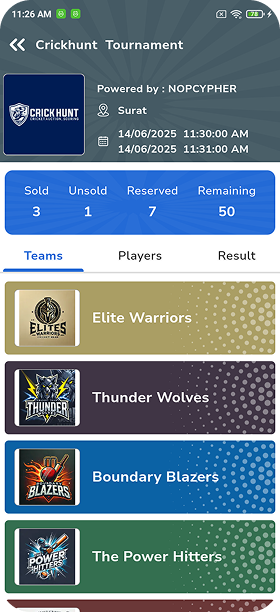
- Remote Bidding — team owners can participate from a phone or laptop within the auction interface, with activity reflected on the main display
- Final Team Management — sold players become part of finalized team squads
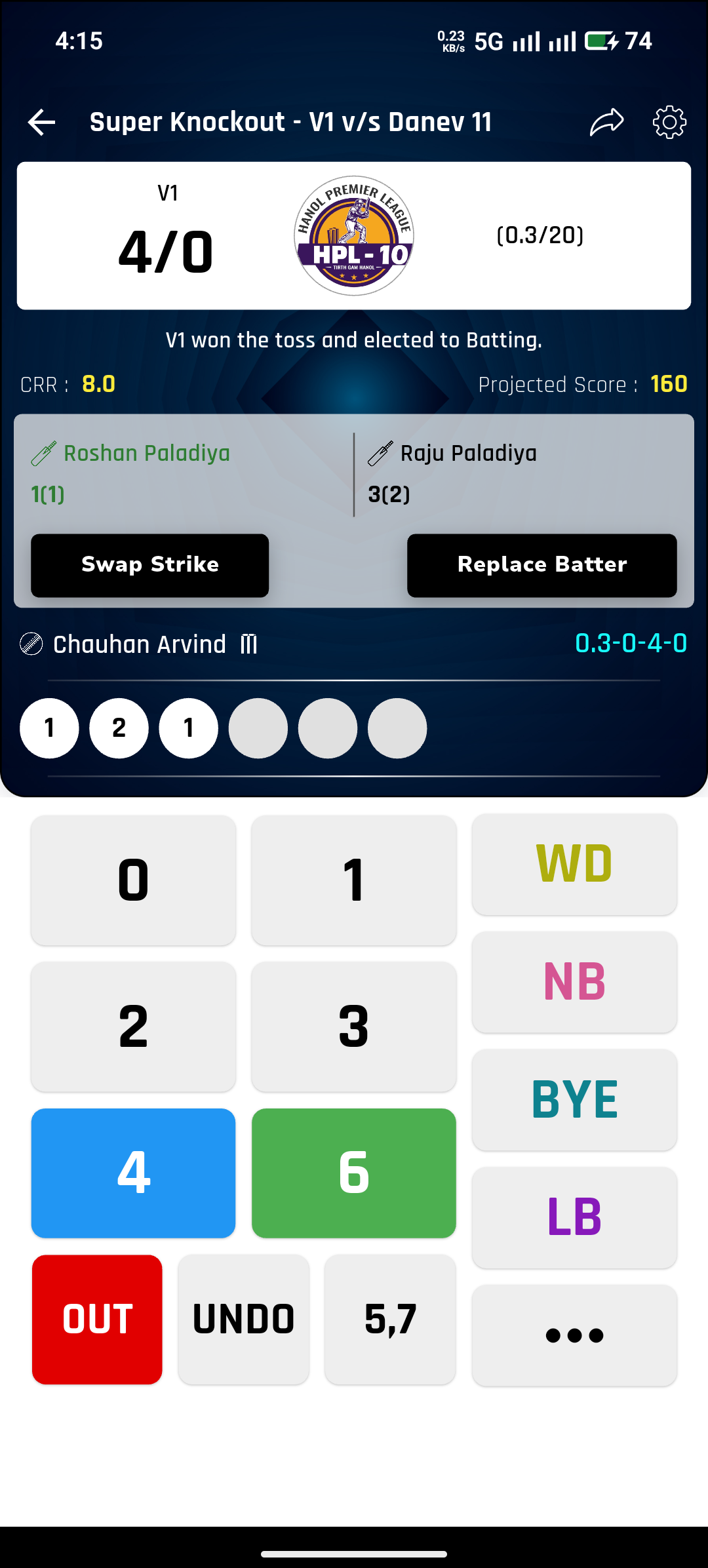
- Live Scoring — once teams are complete, finalized rosters can move into the live scoring workflow
In other words, CrickHunt is not simply a digital bidding screen. It connects the important stages around the auction so organizers don't have to rebuild team and tournament data from scratch after the bidding ends.
Frequently Asked Questions
What is an online cricket player auction?
An online cricket player auction is a digital process where registered players are placed into an auction pool and teams use software to bid on and acquire players through live bidding, with budgets and allocations tracked automatically.
How does a cricket auction work?
Players are registered and verified, organizers create categories and base prices, teams receive budgets, and players are auctioned one at a time. Teams bid until the highest eligible bidder wins the player, and the platform records the allocation automatically.
Can cricket auctions be conducted online?
Yes. Platforms such as CrickHunt support online auctions where team owners can bid remotely from a phone or laptop, while the organizer runs the auction from a central display.
What is a base price in a cricket auction?
The base price is the starting price assigned to a player before bidding begins. Bidding starts at this amount and increases according to predefined increments.
What is a team purse?
A team purse is the virtual budget allotted to a team for purchasing players during the auction. Every winning bid is deducted from the purse, and teams cannot bid beyond their remaining balance.
What happens if nobody bids for a player?
Depending on the tournament rules, the player can be marked unsold and brought back in a later round, offered at a revised base price, or kept outside the final squads.
Can auction data be used after the auction?
Yes. When the auction platform is connected with tournament management, finalized team and player information flows directly into squad management, fixtures, and live match scoring.