
How to Plan a Cricket Tournament Budget: Auction, Ground, Umpires and Scoring
A practical, rupee-by-rupee way to estimate tournament expenses, keep the auction purse separate, plan sponsorship income and avoid match-day surprises.
Figures above come from the hypothetical example later in this guide. They are planning assumptions, not market rates.
Picture this. You have booked the ground for Sunday, announced ₹20,000 in prize money, planned an exciting player auction and confirmed eight teams. Then, three days before the first ball, the real bills arrive: the umpires want a day rate plus travel, the ground charges extra for floodlights, 120 people need water and snacks, and nobody counted the match balls.
That is exactly why a cricket tournament budget matters. The total cost of a tournament depends on its format, the number of teams and matches, the venue, your city and how many days it runs. There is no single price for “a tournament” — but there is a reliable way to calculate yours.
In this guide you will work out your venue, auction, officials, scoring, equipment, prize and refreshment costs, see a fully worked example in INR, learn a simple budget formula and plan how sponsors and registration fees can fund it.
How do you start planning a cricket tournament budget? Fix the format and team count, estimate the number of matches, collect written quotations for the ground and officials, list every other expense category, add a contingency reserve (10–15% is a common planning guideline), then subtract only confirmed income to see how much funding you still need. Keep the player auction purse completely separate from this calculation.
What Is a Cricket Tournament Budget?
A cricket tournament budget is a written plan of every amount the organising committee expects to spend to run the event, and every amount it expects to receive to pay for it. Four terms get mixed up constantly, so let us separate them first.
Everything the organiser plans to spend: operating costs plus contingency. This is what your funding must cover.
The cost of actually running the event — ground, officials, equipment, prizes, refreshments, technology and promotion.
The amount (often points or a notional figure) each team may spend on players in the auction. It belongs to the teams, not the organiser.
A reserve for things you cannot predict: rain delays, overtime, a broken stump or extra balls.
The purse is not your event budget. If eight teams each get a ₹1,00,000 purse, that ₹8,00,000 is not an organiser expense and not organiser revenue. Whether real money changes hands depends on your league rules — either way, record it in a separate auction ledger.
Mixing the two inflates your budget on paper, confuses sponsors about the event’s real size and leads to disputes when teams ask where “their” money went.
Decide the Type and Scale of Your Tournament
Every rupee you estimate later depends on decisions you make now. The most important one is simply how many matches you will actually play, because ground hours, officials, balls and refreshments all scale with it.
- Box cricket vs outdoor cricket: turf slots are usually booked by the hour; a full outdoor ground is often booked by the day or session.
- Friendly vs multi-day tournament: each extra day repeats most match-day costs.
- Knockout vs league: eight teams in a straight knockout play 7 matches; a single round-robin among eight teams needs 28 matches before any playoffs.
- Player auction or fixed squads: an auction adds an event of its own — venue time, a screen, internet and software.
- Live scoring, streaming or broadcast graphics: nice to have for many events, essential for some. Decide early, because they need devices, data and people.
If you are still choosing a format, our guide to cricket tournament fixtures for 4 to 12 teams shows how many matches each structure creates.
Calculate Your Cricket Tournament Expenses
Go through each category below and write down a number — even a rough one. Hover or tap the icon on each card to see how that cost is usually charged.
Cricket Ground or Turf Rental
Box cricket turfs usually charge per hour, often with different rates for day, evening and weekend slots. A full outdoor ground is typically booked per day or per session. A night box-cricket slot in Surat or Ahmedabad and a full outdoor ground on the edge of Vadodara are priced on completely different bases, so never copy someone else’s figure — get your own written quotation.
- Exact booking hours, plus buffer time for toss, breaks and presentation
- Floodlight charges, overtime rate and practice-session rates
- Changing rooms, seating, drinking water and toilets
- Security deposit, cleaning charges and the cancellation or rain policy
Cricket Player Auction Budget and Auction Software
An auction has two completely different money flows. The team purse — along with base prices and bid increments — controls how teams spend on players. The auction operating cost is what you, the organiser, pay to stage it. Only the second belongs in your event budget.
- Team purse allocation, player base prices and bidding increments (see our cricket auction budget and bidding rules)
- Venue time for the auction, plus an auctioneer or host fee if you hire one
- Internet, a projector or display screen and a sound system where needed
- Remote bidding for team owners who cannot attend
- Digital auction records so every team can see its remaining purse
Auction software is only one line in this category, not the whole auction budget. Our step-by-step guide on how to set up a cricket auction covers the rules side in detail.
Umpire, Scorer and Match Officials Fees
Officials may charge per match, per day or under a tournament package. There is no universal umpire fee — it varies with experience, city, match length and how many matches you schedule in a day. Ask your local cricket association or umpires’ panel for references and quotations.
- Number of umpires per match and whether a dedicated scorer is included
- Travel allowance, meals and accommodation for multi-day events
- Overtime rate if matches run late
- A reserve official in case someone drops out
Cricket Scoring and Tournament Management
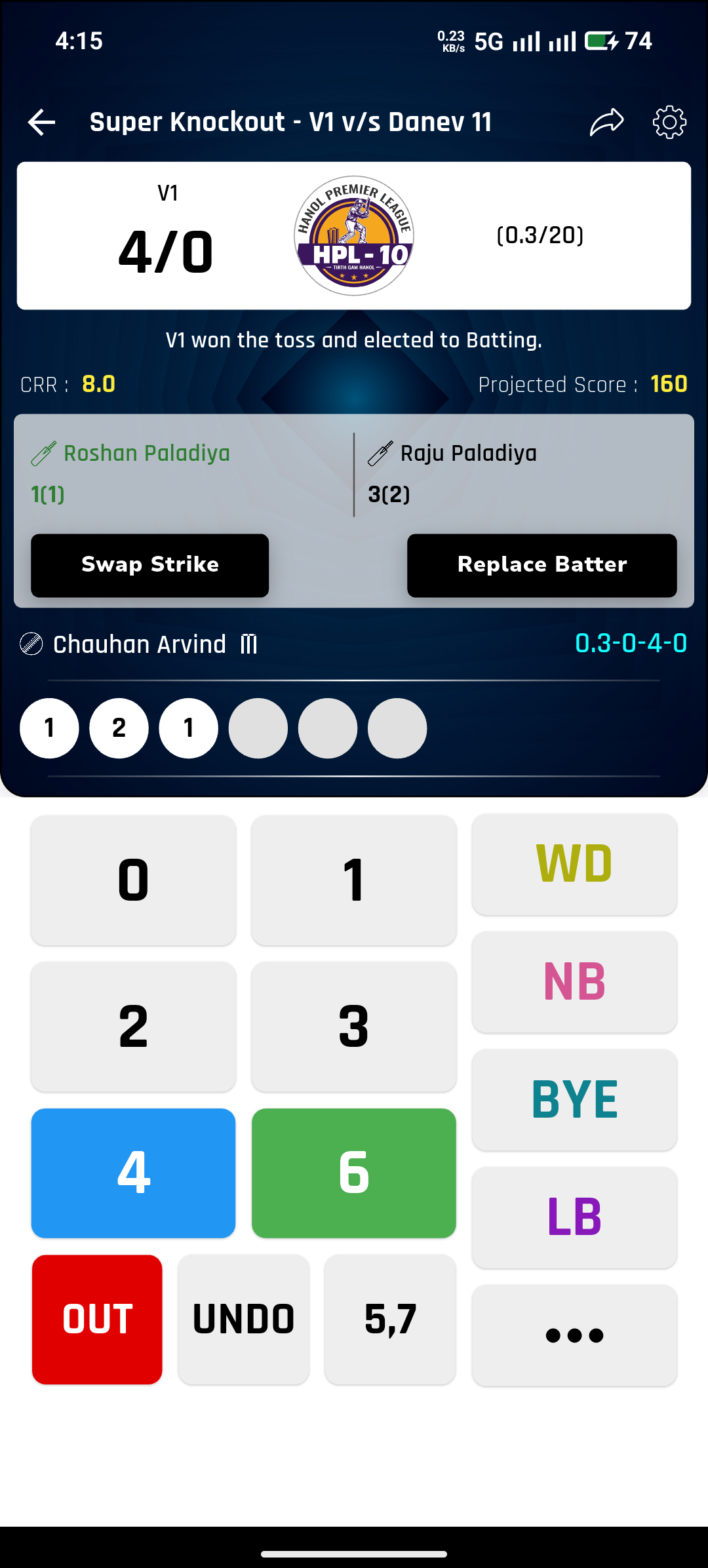
You can score with a paper scorebook, a spreadsheet, a dedicated scorer or digital scoring software. Whatever you choose, budget for the people and devices behind it. Good scoring should capture:
- Ball-by-ball records of runs, wickets, overs and extras
- Batter and bowler statistics
- Match results and an up-to-date points table
- Tournament records for awards like best batter and best bowler
- Score displays or streaming overlays, if you plan to broadcast
Digital cricket tournament management software keeps records consistent and cuts down manual coordination. It will not remove every human error, and it does not automatically make the whole event cheaper — but it does make results, stats and award decisions far easier to verify.
Cricket Equipment and Match-Day Supplies
Split this list into three groups. Consumables (balls, tape, stationery, first-aid refills) are used up. Reusable purchases (stumps, bails, boundary markers, cones, a manual scoreboard) can serve several seasons. Rented items (sight screens, a scoreboard, extra seating) go back after the event. Add bats only if your rules say the organiser supplies them, and always keep spare balls and a replacement set of stumps.
Trophies, Medals and Prize Money
Include winner and runner-up trophies, individual awards (player of the match, best batter, best bowler, player of the tournament), medals and any cash prizes. Confirm prizes before you finalise registration fees or sign sponsors — once a prize is announced publicly, it becomes a commitment you must fund even if a sponsor backs out.
Refreshments, Water and Participant Facilities
Estimate by headcount: players, officials, volunteers and expected guests. A two-hour box cricket event may need only water and a light snack; a full-day or multi-day outdoor tournament needs proper meals, shaded seating, clean toilets, waste bins and someone responsible for keeping them usable. Volunteers need food and water too.
Medical Support, Permissions and Contingency Costs
Keep a stocked first-aid kit, ice packs and a list of emergency contacts and the nearest hospital. Larger events may warrant a trained first-aider on site. Some venues or local authorities require permissions for public events, loudspeakers or temporary structures — requirements vary by venue, format and local rules, so check with the venue and local authorities rather than assuming. Finally, set aside money for weather disruptions and the unexpected.
Marketing, Photography and Live Streaming
Essential: a registration poster, social media posts and a WhatsApp announcement. Upgrades: paid promotion, a photographer or videographer, live streaming equipment, a dedicated internet connection and professional production. Upgrades help sponsors see value, so price them separately and add them only when funding is confirmed.
Cricket Tournament Budget Breakdown — A Practical Example
Here is a hypothetical one-day, eight-team knockout tournament with tennis-ball or leather-ball short-format matches on one outdoor ground in a Gujarat city, plus a player auction held the week before.
Illustrative only. Every amount below is a planning assumption chosen to show the method. These are not verified Indian market rates and not actual CrickHunt customer expenses.
| Expense category | Illustrative (₹) | Share | Why it is needed |
|---|---|---|---|
| Ground rental (full day + lights buffer) | 25,000 | Seven matches plus toss, breaks and presentation | |
| Prize money (winner + runner-up) | 20,000 | Publicly announced, so must be fully funded | |
| Trophies, medals and awards | 12,000 | Team trophies plus individual awards | |
| Refreshments and water (~120 people) | 12,000 | Players, officials, volunteers and guests | |
| Officials and scoring (2 umpires + 1 scorer) | 9,000 | Fair, consistent decisions and accurate records | |
| Marketing and photography | 7,500 | Posters, promotion and sponsor visibility | |
| Equipment and supplies | 6,500 | Balls, stumps, markers, stationery | |
| Auction-day setup (screen, sound, internet) | 5,000 | Lets owners follow bids and purses clearly | |
| Auction and scoring software | 3,000 | Organiser’s software fee only — not the team purse. Check current plans on crickhunt.com/pricing | |
| Medical and miscellaneous | 3,000 | First aid, ice packs, small unplanned items | |
| Contingency reserve (10% of ₹1,03,000) | 10,300 | Rain delays, overtime, replacements | |
| Total planned event expenditure | 1,13,300 | Team auction purses are not included | |
Notice that ground hire and prizes together take about 40% of the budget. That is common: the venue and your public promises drive the total, so negotiate those first.
To use this for your own event, replace every line with a local quotation, delete categories you do not need, and recalculate the contingency on your new subtotal. If each team has an auction purse of, say, 1,00,000 points, that sits in a separate auction sheet and never touches this table.
Create a Cricket Tournament Budget Formula
Two simple formulas keep your spreadsheet honest.
Confirmed income is money that is signed, paid or committed in writing. Expected income is a sponsor who “will probably come in” or teams who have not paid yet. Only confirmed income belongs in the second formula.
If you include registration fees, base them on realistic participation, not the maximum. Allow for teams that withdraw, refunds you have promised and anything the fee includes (for example, kits or meals) — those inclusions are expenses too. Finally, never count the same rupee twice: if a sponsor provides refreshments directly, remove that cost from expenses instead of also adding it as income.
How to Reduce Cricket Tournament Costs Without Making the Event Feel Cheap
Hover or tap each card to see how to apply the tip.
Get at least three written quotes. Compare total hours, lights and deposits — not just the headline rate.
Ask whether water, toilets, changing rooms and cleaning are included before you pay any advance.
Groups plus knockouts give teams more games than a straight knockout without the full cost of a round-robin.
Lock dates in advance and agree travel, meals and overtime in writing to avoid last-minute premiums.
Stumps, cones and boundary markers last several seasons. Store them safely and log what you own.
Offer clear tiers — banner, match-ball, title — with defined benefits so sponsors know exactly what they get.
Compare plans on the pricing page against what your event actually needs. Do not pay for features you will not use.
WhatsApp groups, Instagram and team owners’ own networks often fill registrations without paid ads.
Keep one shared sheet with bills and receipts. Small untracked payments are where budgets quietly leak.
Treat the reserve as untouchable until match day. Do not spend it on upgrades in advance.
Where not to cut: participant safety, first aid, fair officiating and a safe playing surface. Saving money there costs far more in reputation.
How to Fund a Cricket Tournament
Most local tournaments combine several sources. Hover or tap an icon for the key rule.
Illustrative funding calculation
Continuing the same hypothetical event with a planned expenditure of ₹1,13,300:
| Source | Status | Amount (₹) |
|---|---|---|
| Team registration: 8 × ₹8,000 | Paid | 64,000 |
| Title sponsor | Agreement signed | 30,000 |
| Match-ball sponsor | Paid | 7,500 |
| Refreshment sponsor | Verbal only — excluded | (7,500) |
| Confirmed income | 1,01,500 | |
The committee must cover the ₹11,800 gap, cut costs or secure more confirmed sponsorship before committing to spend. If the refreshment sponsor signs, the gap shrinks — but do not spend against a deal that is not confirmed.
Gross collections are not profit. ₹1,01,500 collected is simply money in. Profit (or surplus) only exists after every bill is paid and unused contingency is counted at the end. Many community and institutional tournaments aim to break even, which is perfectly fine.
How CrickHunt Can Help Organise the Digital Side of Your Tournament
CrickHunt describes itself as a real-time cricket scoring and player auction platform, built for leagues, organisers and cricket communities of all sizes. It works on the web and through its app (free on Android and iOS), and handles workflows that would otherwise sit in Excel sheets and manual tasks:
- Player registration through a shareable link, with the organiser reviewing and approving each player
- Team, player and squad management
- Live player auctions with instant bid updates
- Remote bidding, so team owners can bid from their mobile or laptop without being at the venue
- Purse tracking — every bid deducts from the team’s virtual wallet, and bids above a team’s budget are blocked
- Sponsor advertisements on the auction screen
- Ball-by-ball live scoring (currently a beta version) with automatic scorecards, leaderboards and stats
- Premium overlays for live auction and scoring streams
To be clear about the limits: CrickHunt helps you run tournament operations. It does not pay your ground, umpires, prizes or other physical event expenses — those stay in your budget.
You can start for free, and the current plans are listed on the CrickHunt pricing page. Whatever plan you choose, that fee is your cricket auction software cost — it is separate from the team purse and from your total tournament budget. For setup or pricing questions, you can also contact the CrickHunt team.
Registration · Auction · Remote bids · Purse tracking · Sponsor ads · Scoring · Stats · Overlays
Ground hire · Officials · Equipment · Prizes · Refreshments · Medical · Permissions
Cricket Tournament Budget Planning Checklist
Tick each item before you confirm the tournament publicly.
Frequently Asked Questions
How much does it cost to organize a cricket tournament in India?
There is no fixed cost. It depends on the number of teams and matches, box or outdoor format, venue, city, duration, prizes and whether you add an auction, live scoring or streaming. Build your estimate category by category from local quotations, then add a contingency reserve rather than relying on a national average.
What expenses should be included in a cricket tournament budget?
Include ground or turf rental, umpires and scorers, equipment and supplies, trophies and prize money, refreshments and facilities, medical support and permissions, auction setup and software, marketing and photography, and a contingency reserve. Keep team auction purses in a separate ledger.
How much money should be allocated to a cricket player auction?
Separate two figures. The team purse is set by your auction rules and is often in points, so it is not an organiser cost. The organiser’s auction budget covers venue time, screen, sound, internet, any host fee and software. Estimate that second figure from quotations for your actual setup.
Are cricket auction software fees part of the tournament budget?
Yes. The software fee is an operating expense paid by the organiser, so it belongs in your event budget under technology or auction costs. It is usually a small line compared with ground hire or prizes, and it is completely separate from the purse teams use to buy players.
How are cricket ground rental costs calculated?
Turfs usually charge per hour, often varying by time slot and weekday; outdoor grounds are often booked per day or session. Multiply the rate by total hours including buffers, then add lights, overtime, cleaning, deposits and facilities if they are charged separately. Always confirm the cancellation and rain policy.
How much do cricket umpires charge per match?
Fees vary by city, experience, match length and whether officials are paid per match, per day or as a tournament package. Ask your local association or umpires’ panel for quotations, and confirm whether travel, meals, overtime and a scorer are included before booking.
How can sponsors help pay for a cricket tournament?
Sponsors can fund prizes, match balls, refreshments or the whole event in exchange for clearly defined visibility: banners, logos on posts, overlays or naming rights. Offer tiered packages, document each agreement, and count only signed or paid sponsorship when deciding what you can spend.
Can a school or college organize a cricket tournament on a limited budget?
Yes. Use the campus ground, choose a compact knockout or group format, reuse existing equipment, involve student volunteers and keep prizes modest. Many digital tools let you start for free — check the CrickHunt pricing page for current plan options.
How can cricket tournament software help organizers manage an event?
Software centralises player registration, team management, auctions, scoring, points tables and statistics, so information is not scattered across sheets and chats. It reduces manual coordination and makes results easier to verify, but organisers still manage the physical event and its expenses.
How much contingency money should be kept for unexpected expenses?
A reserve of around 10–15% of your operating subtotal is a common planning guideline, not a fixed rule. Outdoor events in uncertain weather, multi-day tournaments and first-time events may justify the higher end. Do not spend the reserve on upgrades before match day.
Final Thoughts — Plan the Budget Before the First Ball
A successful cricket tournament does not need the biggest budget. It needs clear priorities, realistic estimates and confirmed funding, plus transparent expense tracking and the right processes for running the event. Decide your format, gather written quotes, separate the auction purse, protect your contingency and only spend money you actually have.
When you are ready to handle the auction, remote bidding and scoring digitally, CrickHunt is one option worth exploring. For more practical guides, browse the CrickHunt blog.
Set up your auction, invite team owners to bid remotely and keep scores and stats in one place.