
What Is Cricket Player Auction Software?
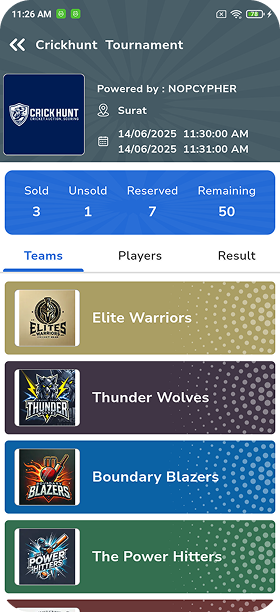
Cricket player auction software is a digital tool that runs a player auction: each team receives a budget, players come up one by one at a starting price, owners bid in set steps, and the software records every sale and every team's remaining purse.
For local leagues, corporate tournaments, academies and box cricket events, it replaces the whiteboard and calculator beside the auctioneer. Nobody has to add up purchases by hand after every sale, and every team sees the same numbers.
The software does not invent your rules; it applies the ones you configure. That is why these four settings deserve thought before auction day. Tap a card to flip it.
How to Set a Cricket Auction Budget
The team auction budget, or team purse, is the total a franchise can spend on players. Set it alongside your expected squad size, never in isolation, because every other setting depends on it.
Each team gets a purse of 84,000 points and expects a squad of 14 players.
This is a planning average, not a rule to spend equally. A strong all-rounder may cost several times 6,000 while a squad player costs far less. The average simply tells you whether your base prices and increments suit the purse.
Keep a reserve for the minimum squad
Before bidding, a team should still be able to fill its remaining minimum slots at base price:
A team has 20,000 points left, needs 4 more players, and the base price is 1,000.
How to Choose Player Base Prices
A base price is the amount at which bidding for a player opens. The final selling price is whatever the winning bid reaches: equal to the base price if only one team bids, or far higher if several teams want the same player.
Base prices should follow your purse and the expected demand. With a 6,000 planning average, a 1,000 base price leaves room for competition; a 5,000 base price would let teams afford only a few players before purses run dry, leaving more players unsold. Many organizers group players into categories:
| Category | Typical profile | Base price |
|---|---|---|
| A | Proven performers | 2,000 |
| B | Regular players | 1,000 |
| C | Newcomers and juniors | 500 |
Illustrative values for an 84,000-point purse, not CrickHunt defaults.
Whatever structure you choose, announce it before bidding starts so no owner is surprised.
Organizers can choose player base prices, so each player opens at the value you announced.
How to Set Minimum and Maximum Squad Limits
A squad limit sets the fewest and the most players each team can buy. The minimum ensures every team can field a side; the maximum stops a well-funded team from hoarding talent.
There is no universal number. Start from your format: players on the field, substitutes your rules allow and reserves for injuries or availability. An eight-a-side box cricket event needs a far smaller squad than an eleven-a-side league played over several weekends.
Organizers can configure minimum and maximum player limits for the auction.
How Cricket Auction Bid Increments Work
A bid increment is the fixed amount by which each new bid must beat the previous one. With a base price of 1,000 and an increment of 500, valid bids run 1,500, 2,000, 2,500 and so on.
Fixed vs tier-based increments
A fixed increment uses one step for the whole auction: easy for new owners, but slow for expensive players. A tier-based increment grows as the price climbs. Compare the bids needed to take a player from 1,000 to 10,000:
Fixed: +500
Tiered
Small steps produce close contests but lengthen the auction. Large steps speed things up but can push a player past a team's purse in one jump. As a rough guide, keep the first step a small fraction of your planning average, then do a short dry run.
Organizers can customise bid increments to suit their tournament.
Which Features Should You Look for in Cricket Auction Software?
Test any platform against the rules you plan to run. This general checklist is for your own notes during a demo or trial; it does not verify any product automatically. For more ideas, see our guide to features to look for in cricket auction software.
How CrickHunt Helps Organizers Manage Auction Rules
CrickHunt lets you set the rules once and apply them consistently. Organizers can set a separate auction budget for each team, choose player base prices, configure minimum and maximum player limits and customise bid increments. If you are new to the platform, start with how to set up a cricket auction.
Choose a bidding type
Organizers also select what bids are counted in: Rupees (₹), Coins, Points, Credits or None. With None, bidding continues as plain numbers with no currency or unit. Pick one below to see it in the demo.
Budget validation: bids beyond the purse are blocked
CrickHunt prevents a team from placing a bid that exceeds its remaining budget. If a team has 500 left and the next bid would be 600, the bid cannot be placed and the message “No budget is remaining.” is displayed.
Illustrative budget check
Hypothetical demo · not the CrickHunt interfaceIllustrative values: team budget 10,000, amount spent 9,500, remaining budget 500, next bid 600. The bid is blocked because 600 is more than the 500 remaining.
No budget is remaining.
Values are hypothetical and not CrickHunt default settings.
Three quick budget checks
Illustrative valuesRemaining budget = Team budget − Amount spent. A bid is affordable only when it does not exceed the remaining budget.
| Team budget | Spent | Remaining | Next bid | Result |
|---|---|---|---|---|
| 10,000 | 9,000 | 1,000 | 600 | Affordable 400 left after the bid |
| 10,000 | 9,500 | 500 | 600 | Blocked 600 is more than 500 — CrickHunt shows “No budget is remaining.” |
| 10,000 | 10,000 | 0 | Any bid | Blocked Full purse spent: no further bids |
Common Cricket Auction Budgeting Mistakes to Avoid
Most auction-day arguments trace back to one of these five planning slips. Flip each card for the fix, and read our guide on cricket auction rules for local tournaments.
Frequently Asked Questions
What is cricket player auction software?
It is a digital tool that runs a player auction, giving each team a budget, opening each player at a base price, accepting bids in set increments and recording every sale and remaining purse.
How do you set a team budget for a cricket auction?
Choose a purse, then divide it by the target squad size to find the average planning budget per player. Check that base prices and increments fit comfortably within that average.
What is a player base price?
The base price is the opening bid for a player. The final selling price can match it or rise well above it, depending on demand.
How do bid increments work?
Each new bid must exceed the previous one by the set increment. With a 1,000 base price and a 500 increment, the next bids are 1,500, 2,000 and so on.
How many players should each team select?
It depends on your tournament rules: players on the field, permitted substitutes and the reserves you need across the event.
Why are minimum and maximum squad limits important?
The minimum makes sure every team can field a side; the maximum stops one team from buying too many players and weakening the competition.
Can cricket auction software prevent teams from bidding beyond their budget?
Some platforms can. CrickHunt blocks any bid that exceeds a team's remaining budget and displays “No budget is remaining.”
What bidding types does CrickHunt support?
Rupees (₹), Coins, Points, Credits and None. With None, bids are plain numbers without a currency or unit.
Can organizers customise auction budgets, base prices and bid increments?
Yes. In CrickHunt, organizers set a separate budget for each team, choose base prices, configure minimum and maximum player limits and customise bid increments.
Final Thoughts: Choose Cricket Auction Software That Fits Your Tournament
A fair auction starts with numbers everyone understands. Set the purse with your squad size in mind, keep base prices below the planning average, fix squad limits from your playing rules and choose increments that suit your price range. Then publish the rules and let the software apply them. For auction-day conduct, read how to conduct a cricket player auction teams trust, or browse the CrickHunt blog.